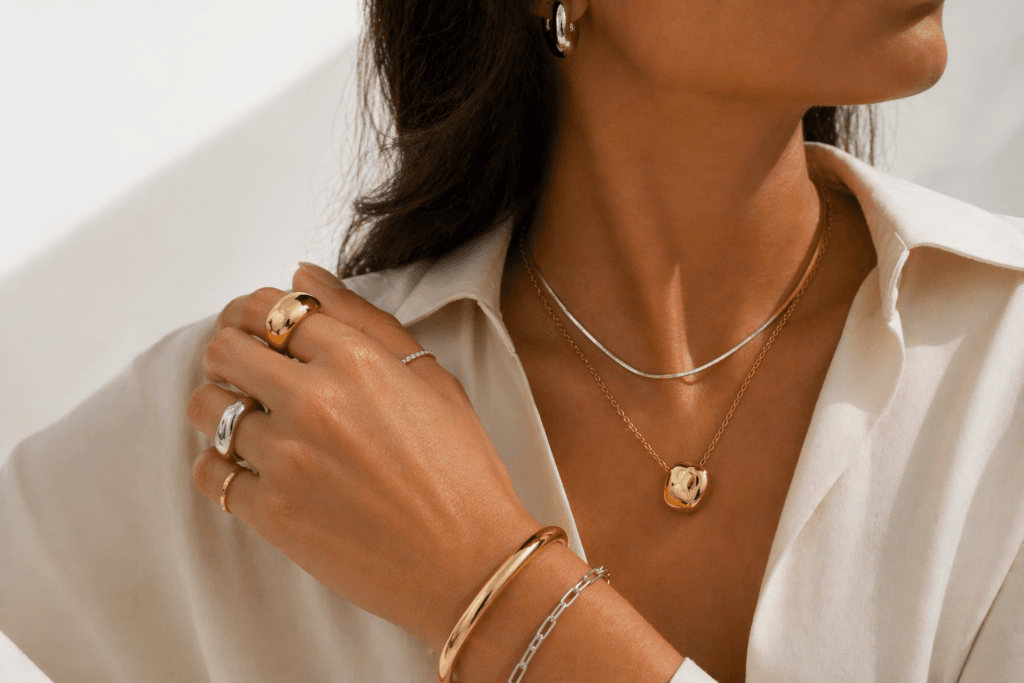
Mixing gold and silver jewelry works when there is intention and balance. If you want to combine gold and silver without making mistakes, follow these three simple rules to create harmony and a cohesive everyday look.
Mixing Gold and Silver Jewelry: the essentials in 30 seconds
- Define one dominant metal and use the other as an accent.
- Follow a 2:1 ratio and repeat the secondary metal at least twice.
- Match finishes and textures to avoid visual clutter.
Rule 1: Define the dominant metal

- Choose the metal that will lead the look (for example, gold) and use the other (silver) as a detail.
- Keep the dominant metal in the most visible pieces (watch, main necklace) and use the secondary metal in smaller highlights (slim ring, small hoops).
- Avoid switching the dominant metal within the same outfit.
Rule 2: Repetition and the 2:1 ratio
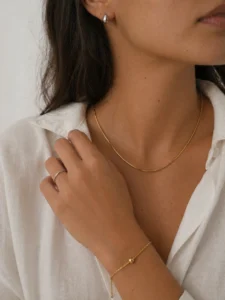
- Apply the 2:1 ratio: two elements in the dominant metal for every one element in the secondary metal.
- Repeat the secondary metal at least twice (for example, slim rings and a necklace clasp).
- Spread the secondary metal across different areas (hands and neck) to make the combination feel intentional.
Rule 3: Textures and finishes that create balance
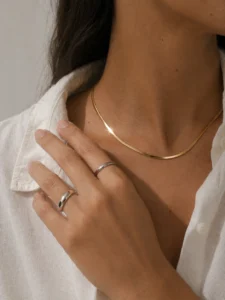
- If the dominant metal is polished, keep the secondary metal polished or softly satin-finished as well.
- Avoid combining too many finishes in the same look (polished, brushed, hammered, and pavé-set all at once).
- A single sparkling detail, such as a small zirconia stone, is enough to create a focal point.
Ready-made mixed-metal looks
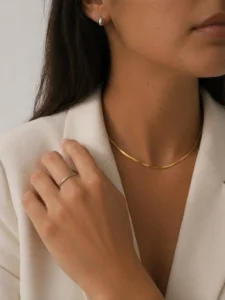
Work
- Gold dominant: polished short necklace.
- Silver accents: slim ring and small hoop earrings.
Casual
- Gold dominant: bracelet and medium-length necklace.
- Silver accents: two slim rings on different hands.
Evening
- Silver dominant: long necklace and understated earrings.
- Gold accents: slim bracelet and a detailed ring.
Combining earrings, necklaces, and rings
- Keep the necklace in the dominant metal and repeat the secondary metal in earrings or rings.
- In layered necklaces, use a single accent in the secondary metal to avoid competition.
- On the hands, alternate metals between fingers to avoid concentrating everything in one area.
Common mistakes when mixing gold and silver jewelry
- Changing the dominant metal halfway through the look.
- Using three different metals in the same combination.
- Overloading the look with too many textures and stones.
Quick questions about mixing gold and silver jewelry
- How many pieces in the secondary metal should I wear? Two is usually the minimum for a cohesive look.
- Can I wear a watch in one metal and rings in another? Yes, as long as you follow the 2:1 ratio.
- What about layered necklaces? Keep the dominant metal in the main layers and use only one detail in the secondary metal.
How MAWAD suggests wearing mixed metals
At MAWAD, we focus on consistency: define the dominant metal, apply the 2:1 ratio, and repeat the secondary metal in strategic places. The result is a natural-looking mix of gold and silver jewelry without visual clutter.